
Dogs — They get it
FRONT LINES

Sparing readers yet another plea for new animal rights law du jour, another horrifying abuse story, or a call to rise from the couch and take action, I instead wanted to share something quieter—an observation that struck me deeply. A moment that, in its simplicity, further demonstrated the extraordinary interconnectedness between humans and dogs, unlike any other relationship in the animal world.
Have you ever wondered what dogs are thinking at certain moments?
Recently, I took my sweet Bella to the shores of Lake Michigan—for those of us living in the Midwest, perhaps the closest resemblance to an ocean. Every year, when we make the trek, her excitement unfolds in stages. First comes the eager walk from the parking lot. Then the winding path through the forest preserve, the smell of pine needles, the pattering of her paws, and the furious clicking of her nails across the wooden boardwalk as anticipation overtakes her. Finally, the sand appears, stretching toward the endless horizon of water—so vast and open that, looking outward, no land is visible.
But it is what happens next that always captures me.
The moment Bella reaches the shoreline and takes in the vastness before her, a stillness overtakes her entirely. The frantic energy disappears. She stops running. Stops searching. Instead, she simply sits in the sand and stares out at the endless expanse of water, her nose lifted into the breeze, taking in the scent of the lake while gazing at the horizon as though captivated by something far greater than herself.
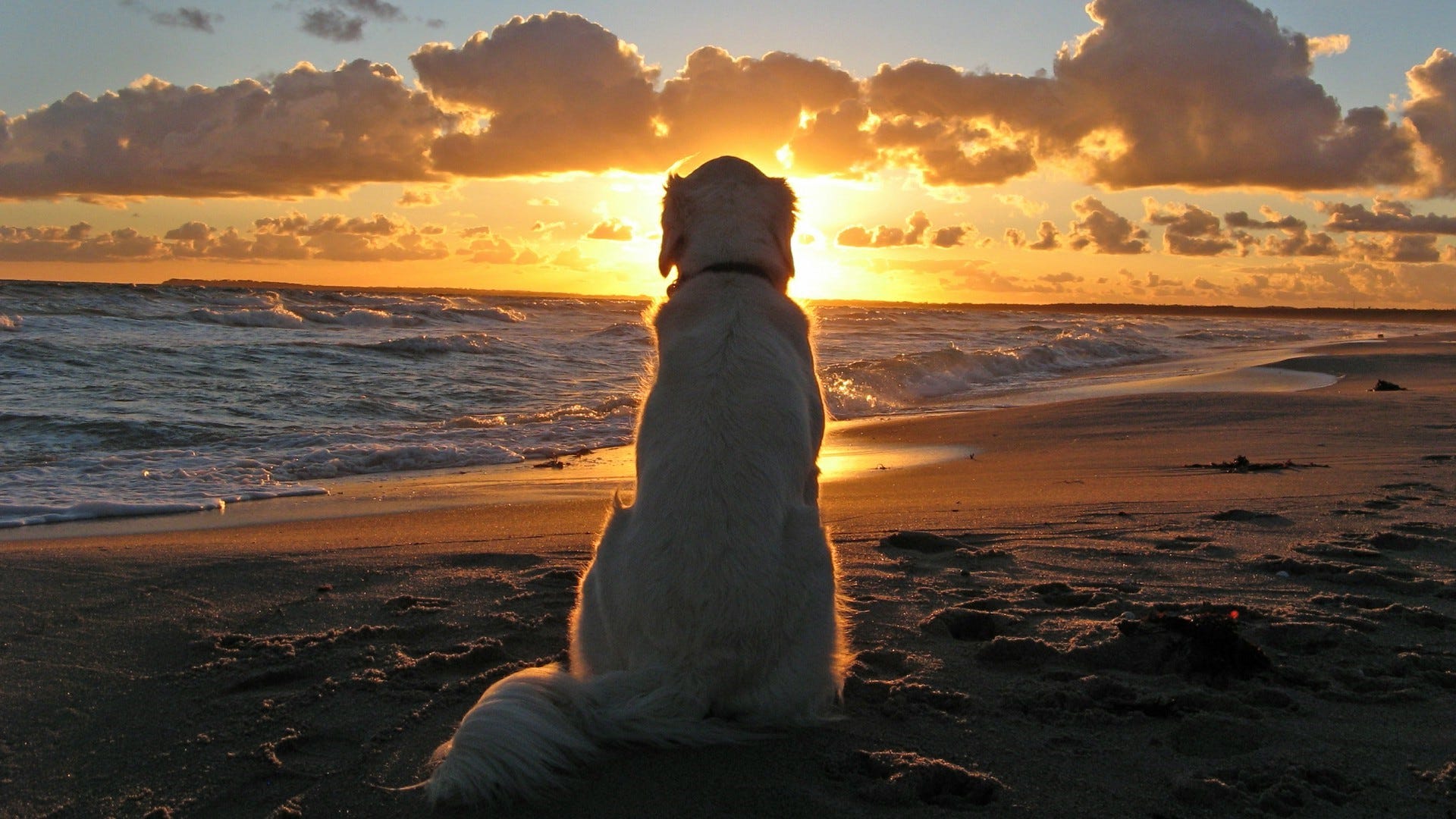
Much like humans, lost in our thoughts and perhaps solitude, there is something almost testimonial about her experience.
In those moments, she appears suspended in thought, almost contemplative. There is an awe in her mannerisms — suddenly silent and still, a recognition of the magnitude, mystery, and something larger than herself. It reminds me of the same feeling humans experience when standing before the ocean, staring into the night sky, or confronting the quiet realization of our own smallness in an incomprehensibly larger world and our eventual mortality.
The coolness of the morning air. The smell of damp earth and morning dew. The distinctive scent of fresh water carried by the wind. The rhythmic sound of waves lapping against the shore, and the immeasurable body of water before her. Dogs notice these things with an intensity we humans often lose somewhere between adulthood and routine.
And I cannot help but wonder - Is she feeling some version of what we feel?
Not in the simplistic way many will dismiss and frame animals as creatures driven only by instinct or conditioned response, but something deeper. A primitive awareness. A sense of wonder. A momentary peace that quiets anxiety and places life into perspective. Surely, if you have ever taken your own dog to the ocean, a lake, or any place where nature suddenly reveals its immensity, you have witnessed this too. That pause. That stillness. A contemplation of something beyond themselves.
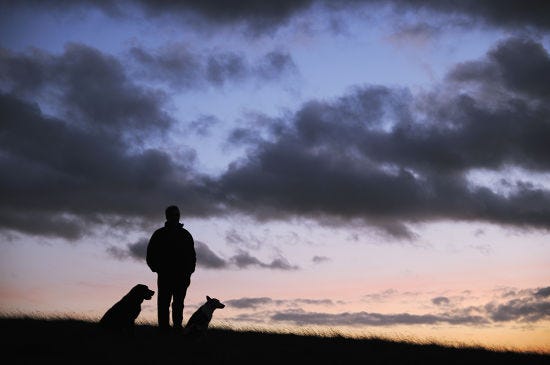
Perhaps dogs do not contemplate mortality in the philosophical way humans do. Perhaps they do not assign language to existence or search for meaning through religion, poetry, or science. But it is increasingly difficult to deny that they experience emotional worlds similar to our own.
Anyone who has lived alongside a dog already knows this intuitively.
They grieve when they lose companions. They suffer loneliness and anxiety. They demonstrate jealousy, empathy, anticipation, guilt, affection, and joy. They seek comfort during fear and companionship during uncertainty. They remember kindness. They remember cruelty.
And remarkably, science continues to affirm what many dog owners have always known.
Research over the past two decades has revealed that when humans and dogs gaze into each other’s eyes, both species experience a release of oxytocin—the same hormone associated with bonding between mothers and infants. In essence, dogs and humans have developed a biological attachment system remarkably similar to that of parent and child relationships.
Other studies using MRI imaging have demonstrated that dogs process emotion in ways strikingly comparable to humans. Neuroscientists have identified activity in canine brain regions associated with positive emotion when dogs hear the voices of their humans. Researchers have also found evidence that dogs can distinguish human emotional expressions, responding differently to happiness, anger, sadness, and fear.
Even more astonishing is that dogs evolved alongside us. Over thousands of years, they did not merely learn to tolerate humans; they adapted to understand us. They read our gestures, interpret our facial expressions, follow our gaze, and respond to our emotions with a sensitivity unmatched in the animal kingdom.
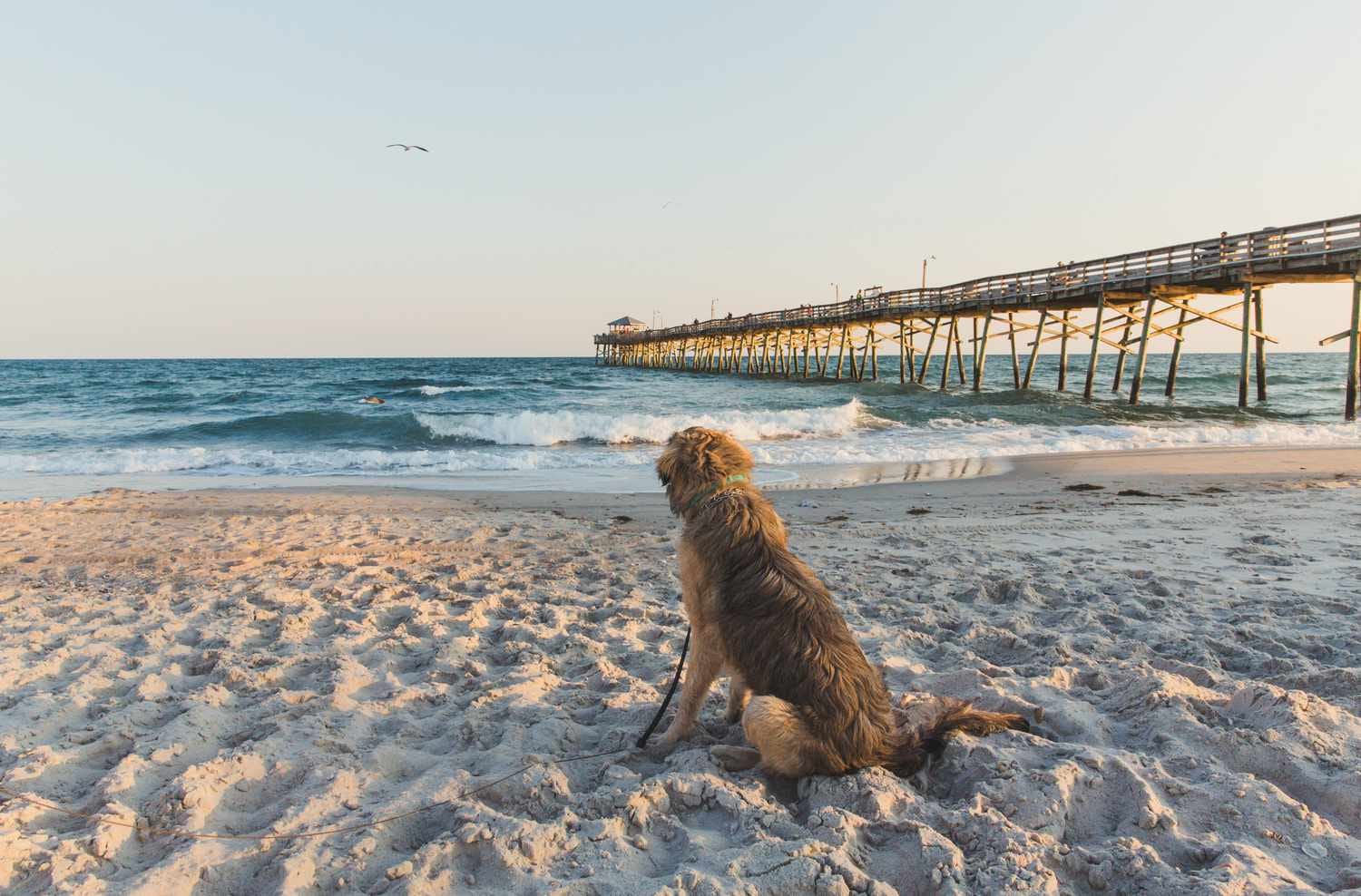
Perhaps that is why moments like Bella sitting silently before the waters of Lake Michigan feel so strangely familiar. Because somewhere within them exists not merely obedience or instinct, but consciousness intertwined with ours through thousands of years of companionship, survival, and emotional evolution.
Not lesser beings moving mechanically through existence, but emotional creatures navigating fear, wonder, attachment, and the search for comfort in a world they cannot fully understand—just as we do.
Dogs understand us because, in many ways, they are like us.
Dogs - They get it….
we need to be more like dogs.